HYVE LLM Creator
Coming soon.
Coming soon.
HYVE ETHER OS
Your computer back.
Every feature inside HYVE Ether OS. Built around the agent. You own your AI and your data.
Coming soon.
Coming soon.
Designed for the day quantum computers can break today's public-key encryption.
HYVE's design uses ML-KEM-768 post-quantum key exchange; it is not yet in the shipped build. The designed substrate seals data in fixed 512-byte encrypted cells (ChaCha20-Poly1305 AEAD, Ed25519 signatures, blind routing tokens); today the cell format is used only by HYVE's device-to-device messaging, which is in development.
Your data, your keys, your signature.
Per-chunk Brotli + AES-256-GCM encryption with an Ed25519-signed root hash you can verify offline, plus SQLite-indexed metadata; one vault unlock decrypts every archive. (NOT yet in the shipped build: Reed-Solomon GF(256) parity shards + Particle-Swarm-Optimized layout for partial-corruption survival — the designed next layer.)
REAL SCREENSHOTS · LIVE BUILD
Every image below is a direct capture from a running HYVE Ether OS install — the twin-star Ether desktop, the app grid, Omega at work, a preview of Alfred (coming soon), image generation in HYVE Spark, and a live 3D map of the entire OS. Not a mockup.
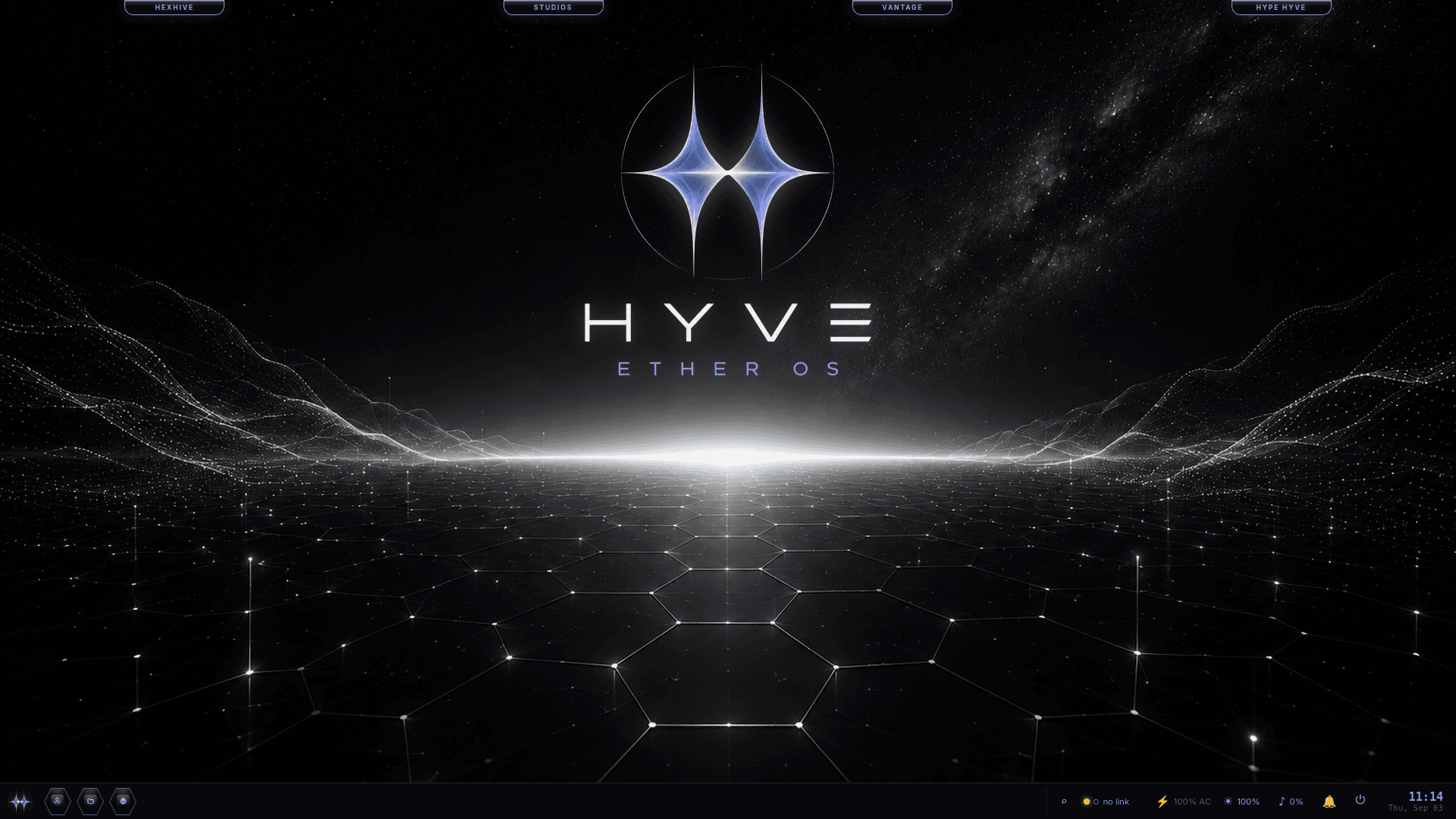
DESKTOP · HYVE ETHER OS
The twin-star emblem over a hex-horizon wallpaper — azure and violet on black. Four pop-out rails dock at the top: HEXHIVE (quick-launch), STUDIOS (the creative suite), VANTAGE (observability & security), and HYPE HYVE (social). The bottom taskbar carries the launcher, pinned apps, and the system tray — battery, brightness, network, time. Quiet by default: no ads, no upsell modals, no telemetry.
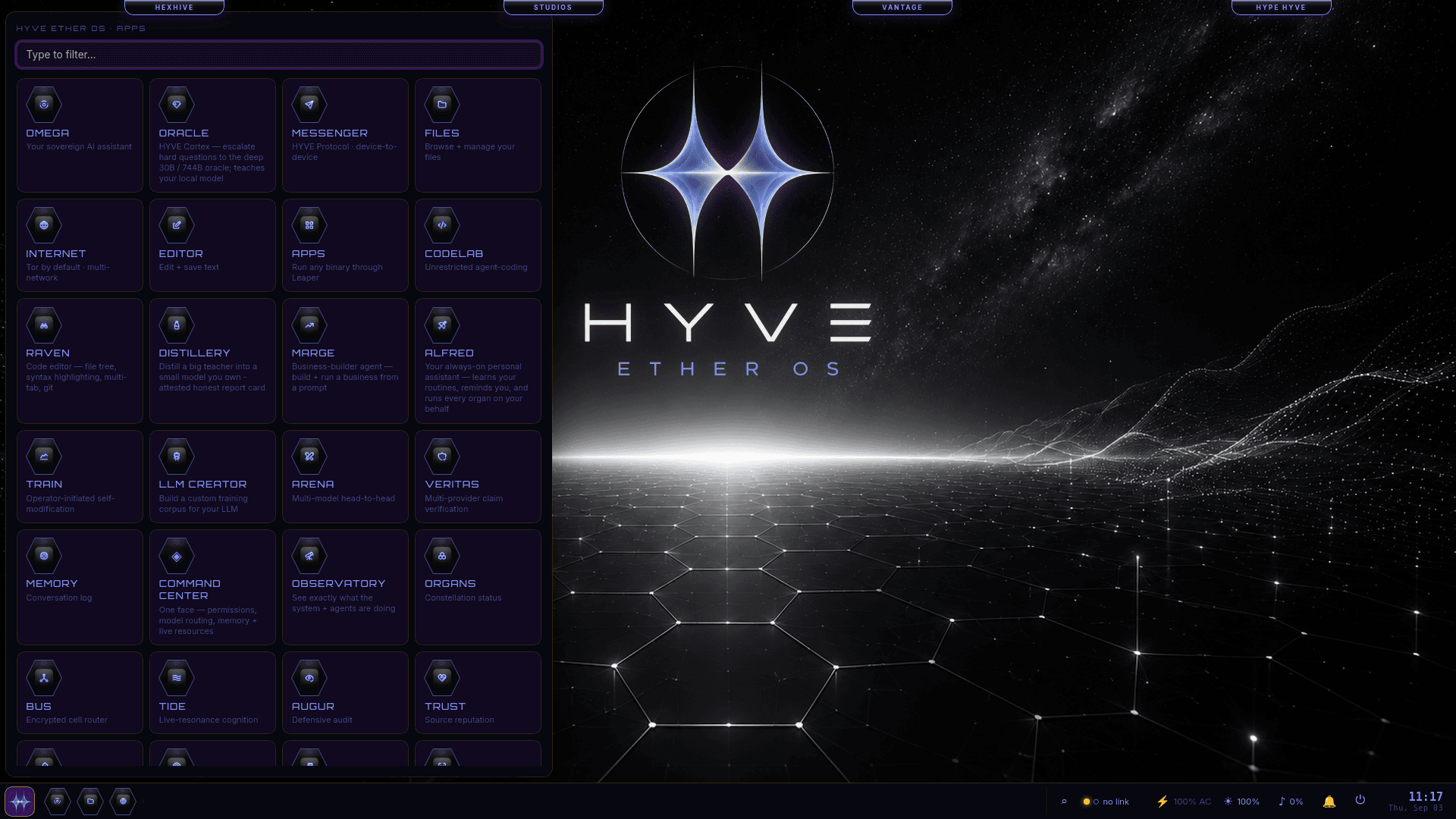
EVERYTHING INSIDE · APP GRID
OMEGA — your sovereign AI assistant. ORACLE — hand harder questions to a larger local model when your hardware has room for one. MESSENGER — device-to-device messaging, in development. CODELAB — agent-assisted coding. DISTILLERY — in testing for the next build. MARGE — build and run a business from a prompt. LLM CREATOR — coming soon. Plus RAVEN, FILES, INTERNET, EDITOR, TRAIN, ARENA, VERITAS, MEMORY, COMMAND CENTER, OBSERVATORY, ORGANS — and more.
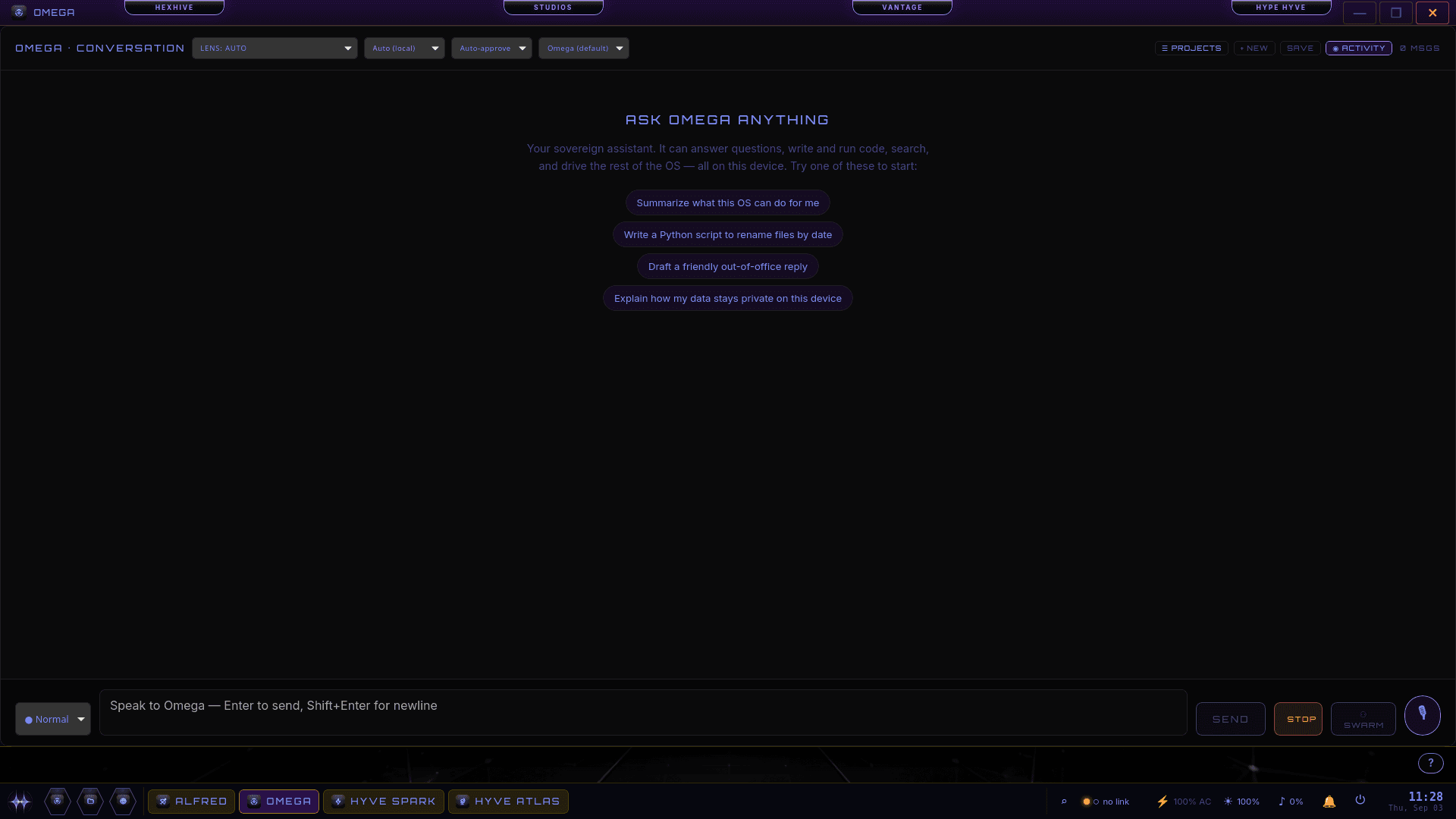
SOVEREIGN AI · OMEGA
Your sovereign assistant answers questions, writes and runs code, searches the web, and drives the rest of the OS — with the AI running on this device. Choose a lens, a model, and an approval mode. In the 3.0 build now in testing, shell commands are off until you turn them on, and the agent's actions pass a default-deny policy check. Run it solo or fan the work out to a SWARM. Local models, no API bill, no telemetry; web search, when you use it, goes over the internet.
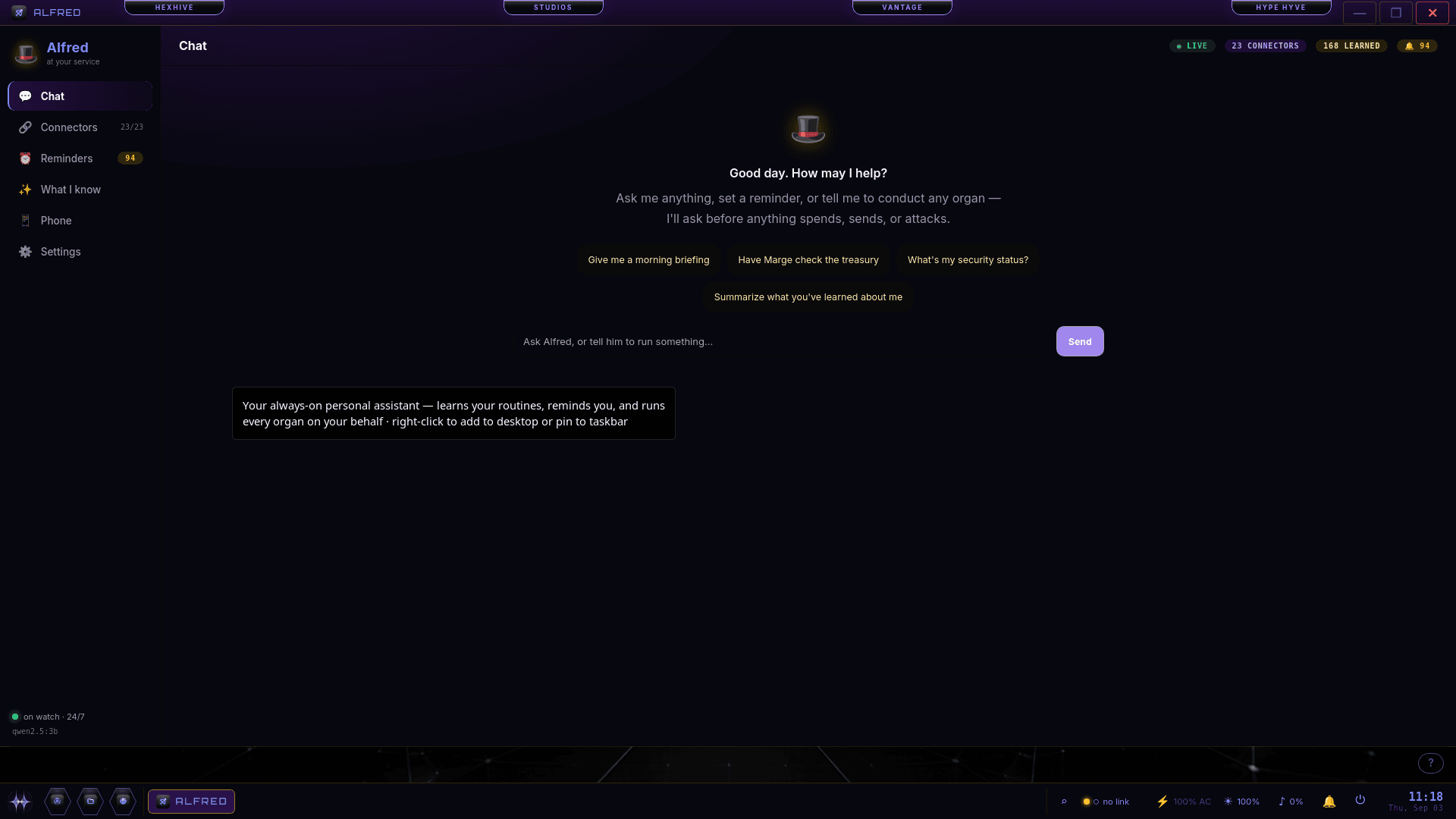
COMING SOON · ALFRED
Alfred, the always-on assistant, is coming soon. Features shown may change before release.
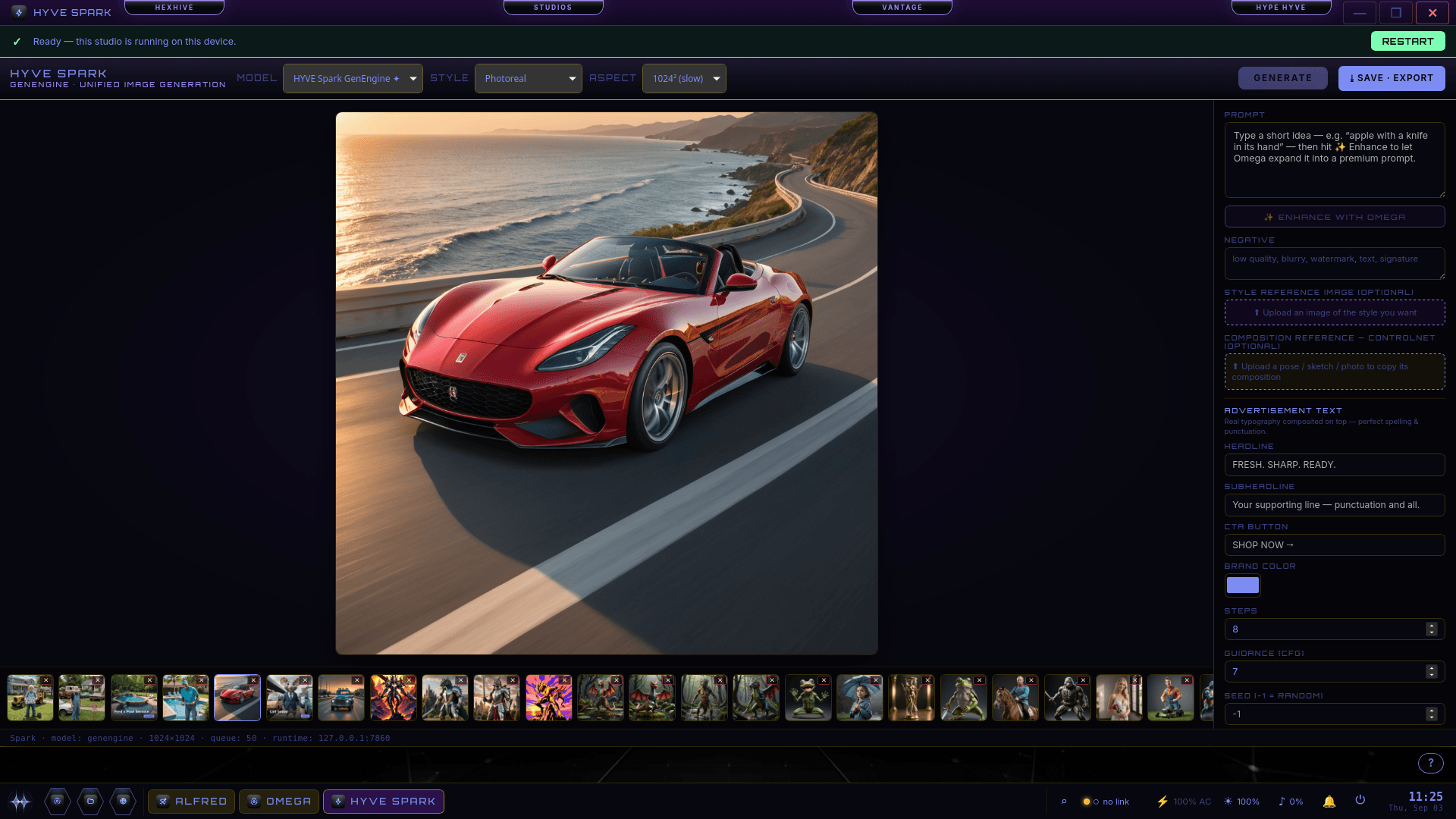
LOCAL IMAGE GEN · HYVE SPARK
“Ready — this studio is running on this device.” Type an idea, let Omega enhance it into a premium prompt, pick a style and aspect, and generate — photoreal or stylized. ControlNet composition, style references, real composited ad typography, and a gallery of everything you’ve made. Nothing uploaded, nothing metered.
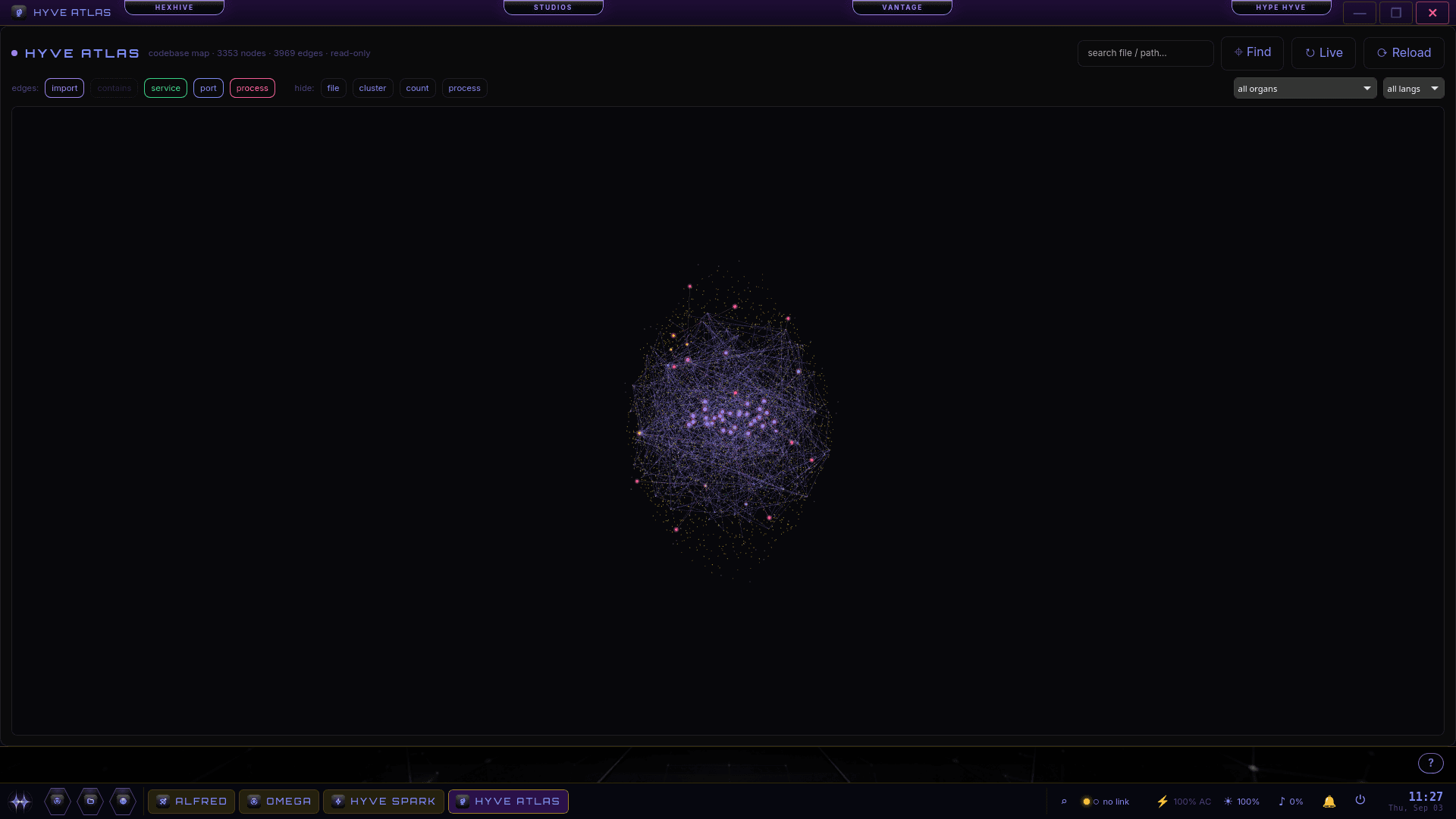
THE OS, MAPPED · HYVE ATLAS
HYVE Atlas renders the entire codebase as a 3D force-graph — 3,353 nodes and 3,969 edges of files, services, ports and processes, and exactly how they connect. Filter by organ, language, or edge type, search any path, and watch it update live. An OS that can show you itself.
LAYER 01 · COGNITION
Omega is the decision orchestrator at the heart of every HYVE agent. Same input, same output, every time, under 200 nanoseconds per rule. HYVE LLM Creator is coming soon.
Omega is the decision orchestrator at the heart of every HYVE agent. It runs a deterministic decide() function — same input, same output, every time, under 200 nanoseconds per rule — over a topologically-sorted multi-organ topology. Every verdict is replayable in Observatory.
Coming soon.
A design in a pending patent claim, not a shipped capability: routing work across quantum, classical, and local compute.
Three-dimensional graph of organ nodes on a Fibonacci-sphere distribution, lightning polylines for cell deliveries, color-coded by topic class across at least 8 categories. Every decision, memory write, and bus event is replayable.
LAYER 02 · EXECUTION SUBSTRATE
HYVE Leaper runs Windows apps (via Wine), containers, Flatpak apps, and retro game ROMs alongside native Linux apps.
SUPPORTED FORMATS
Designed: a four-tier, provenance-keyed execution sandbox (KnownSigned / AiGenerated / UserUploaded / Unknown) that picks each program's isolation from where it came from. Not yet in the shipped build. In the 3.0 build now in testing, code the agent writes for apps runs in a Linux Landlock + seccomp sandbox.
LAYER 03 · STUDIOS
Seven first-party studios cover image, audio, video, motion capture, ambient sensing, API orchestration, and prompt management. Each is scriptable; each is composable; each is built to run on your machine.
Image generation
Audio generation
Video generation (Anima engine)
Markerless motion capture
Ambient context (Aura engine)
1,450 APIs · recipe scheduler
Master prompt library
Cinema is powered by the Anima engine. Sense is powered by the Aura engine; it is in development and needs add-on ESP32-S3 sensor boards. Both are built to run on your hardware.
LAYER 04 · SECURITY
HYVE's design uses ML-KEM-768 post-quantum key exchange; it is not yet in the shipped build. The full posture lives at /security.
HYVE's design uses ML-KEM-768 post-quantum key exchange, ChaCha20-Poly1305 AEAD, and Ed25519 signatures; it is not yet in the shipped build. Today files in ~/.hyve/ are not encrypted at rest, and device-to-device messaging is still in development.
Eleven static analysis detectors across five languages: secrets, weak_crypto, sql_injection, command_injection, deserialization, insecure_random, unsafe_audit, panic_audit, xss, regex_dos, ssrf.
A design in a pending patent claim: Augur audits its own source on every commit, so the security tool checks itself before anything else.
A tarpit organ that drips fake banners to attackers for hours, a Tor controller organ with pluggable transports (obfs4, meek_lite, snowflake), and a sentinel kill organ for cross-platform process termination — all audit-logged.
LAYER 05 · IDENTITY & DATA
Your identity lives on your hardware. Your archives live on your hardware.
Sovereign on-device identity: X25519 master keypair and HKDF-derived scoped tokens. No cloud account required.
Per-chunk Brotli + AES-256-GCM encryption with an Ed25519-signed root hash you can verify offline, plus SQLite-indexed metadata; one vault unlock decrypts every archive. (NOT yet in the shipped build: Reed-Solomon GF(256) parity shards + Particle-Swarm-Optimized layout for partial-corruption survival — the designed next layer.)
Part of HYVE's device-to-device messaging, which is in development: messages exceeding 387 bytes are split via Shamir K-of-N secret sharing applied per byte position over GF(256). Any K cells reconstruct the original; any K-1 cells reveal nothing.
Unlock verification with length-capped inputs, parallel Argon2id derivations without short-circuit, bitwise-AND combination, and uniform error message on failure — defends against side-channel timing attacks.
Part of HYVE's device-to-device messaging, which is in development: per-conversation epochs with chain-key rotation via HKDF-SHA256 and zeroized prior keys, designed so that compromising the current state does not expose past traffic.
Peer-to-peer LAN file transfer organ — mDNS discovery, TLS-fingerprint pinning, no relay server, up to 8 GiB per file. Transfers go directly between devices on your local network.
LAYER 06 · INTEGRATIONS
HYVE MCP Bridge exposes Omega, Narrator, Augur, Trust, and Leaper as native MCP tools — call them directly from Claude Code, Cursor, Zed, or Continue.dev. Full integration guide at /skills.
A standalone binary that exposes Omega, Narrator, Augur, Trust, and Leaper as native MCP tools — call HYVE organs directly from Claude Code, Cursor, Zed, and Continue.dev.
Per-IDE skill manifests (.claude/skills, .cursor/rules, ~/.continue/config.json) so operators invoke HYVE organs from inside their AI coding harness without leaving the editor.
Six plugin types with manifest-based install on ports 7900–7999 — Studios, organs, themes, recipes, surfaces, agents — all extendable.
LAYER 07 · HARDWARE
HYVE Ether OS targets standard x86_64 desktops and laptops. The minimum specs, the team's own development and test machines, and the explicit unsupported list are at /hardware. Those machines run our development builds; the list is not a compatibility certification. Check your machine against the minimum below.
MINIMUM
4+ CPU cores · 8 GB RAM (16 GB recommended) · ~105 GB free disk · 128 GB+ USB stick · dedicated GPU optional (AI is slower without one) · UEFI or Legacy BIOS · AES-NI + AVX2
RECOMMENDED
8+ cores · 16 GB RAM · 256 GB NVMe · NVIDIA RTX 3060+ for Studios
CLOSED BETA · BY REQUEST
HYVE Ether OS is in closed beta — access is by request, not a public sale. Real users help shape real software as it hardens. Full public launch date to be announced. Stop renting your intelligence.
Request Beta Access